


Digital Branding vs Traditional Branding: Key Differences
Free
Free Wi-Fi
Branding historically has been about creating perceived ideas of the company. The methods used to establish this perception have changed over time as well. Today, companies frequently compare digital branding with traditional branding to determine where they should be focusing their efforts. By understanding how digital and traditional branding differ from each other, companies can develop an effective branding strategy that includes both forms of branding.
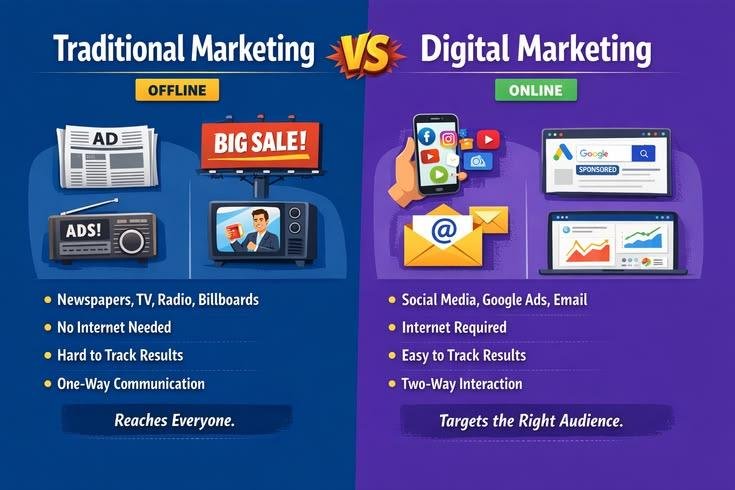
Traditional Branding is the term used to describe how a company uses marketing strategies that occur outside of the Internet; for example, print ads, television commercials, radio ads, billboards, brochures, and live events. For decades now, traditional advertising/marketing has been the dominant branding type.
Some Characteristics of Traditional Branding include:
-
Targeting Wider Audiences: Traditional media's audience is generally a large mass of people versus a distinct segment of people.
-
Communication is One-Way: With traditional branding, the branding message only goes from the branding company to the customer. There is very little opportunity for two-way communication between those two parties (customer to brand).
-
Advertising is Limited to Local Market: Traditional branding can only be used in specific cities/regions and does not provide the same opportunities as digital branding for marketing to a targeted audience beyond a city/region.
-
Longer Timeframes for Advertising Campaigns: Traditional campaigns often require a lot of planning and lead times, resulting in a lengthy development period (i.e., planning, approvals, production, distribution, etc.) and may involve significant monetary costs.
With these characteristics, traditional branding can support strong memory of a brand name, especially if the advertising message is the same. However, it is sometimes difficult to measure the true impact of traditional branding.
What are Some of the Characteristics of Digital Branding?
Digital branding is the practice of establishing a brand's presence on various online platforms, including social media, search engines, email marketing, and mobile apps. In today's interconnected world, branding digitally has become a core component of every company's strategy for communicating with potential customers.
For example, when searching for the top digital marketing company in the DELHI NCR area, companies need to consider their digital visibility and results to determine which digital marketing company will best support their overall branding strategy.
Characteristics of Digital Branding
1) Targeting the Right Audience: using digital tools to identify and reach the right customers based on their demographic information (i.e. people based on their age, gender, occupation), their interests (i.e. what they like), behaviour (ie. What are their habits), and location (i.e. where they live).
2) Two-way communication: customers can interact with brands through social media comments, reviews, and direct messages on social networks.
3) Real-time analytics: you can track how well a campaign is being executed by reviewing metrics such as clicks, views, impressions, etc.
4) Budget flexibility: companies can make quick adjustments to their campaigns based on the performance tracked by the metrics discussed above.
Companies looking for the best digital marketing agency in Tilak Nagar are actively exploring the use of digital platforms to increase customer engagement and enhance their branding efforts in targeted communities.
Major Differences Between Digital and Traditional Branding
1. Availability and Reach
With traditional branding, typically there is a dependence on a location to promote your brand in person or to advertise through scheduled broadcasts. While with digital branding you have the ability to promote your brand around the clock from anywhere in the world. By having a website and a social media page you are able to connect with customers in any timezone at no extra cost for distributing your brand message.
2. Cost
Traditional brand campaigns generally are more expensive to produce and distribute than digital brand campaigns. It may require a larger budget upfront with traditional brand campaigns. However, you can start with small budgets and grow your brand through the internet with digital marketing. This flexibility is also one of the reasons that so many companies use the best digital marketing company in Delhi NCR to help them with their online branding.
3. Measurement
When trying to measure how well traditional branding was executed, usually you would want to conduct a survey after some time passes or only look at the sales data over time. With digital branding, you have access to detailed data analytics (e.g., conversion rates, website audience analysis, etc.) that allow you to measure and refine your marketing strategy with more precision.
4. Level of Engagement
For the most part traditional branding provides one-way communication and the audience usually receives just information. With digital branding, you not only provide the audience with information but also encourage them to engage back with your brand. By providing interactive content, hosting live sessions, and discussing with your audience on social media, brands can strengthen their connection with their audience.
If you are trying to decide between going with an online or offline branding campaign, the best thing you can do is to work with the best digital marketing agency in Tilak Nagar to learn about how digital tools can enhance or even replace some of the activities involved in creating a traditional branding campaign.
Conclusion
In conclusion, there are benefits to using both digital and traditional branding. Traditional branding is great for building local brand awareness, while digital branding provides companies with more data-driven analysis tools and allows them to engage with their customers in an interactive format. The decision of which type of branding to pursue really depends on the target audience, business goals and available resources of your company. In addition to that, a mixture of both will help your brand develop over time through a balanced approach between both the traditional and digital branding methods.
Companies like RB Digital & Social Media Solutions are doing research into the differences between these two types of branding in order to provide businesses with insight into how branding methods will continue to change in a highly competitive market.

 English
 Arabic
 French
 Spanish
 Portuguese
 Deutsch
 Turkish
 Dutch
Dutch
 Italiano
 Russian
 Portuguese (Brazil)
 Greek
Greek