


Growing Retail and E-Commerce Sectors Propel Digitization in the Logistics Supply Chain Market
Digitization in logistics supply chains involves transforming traditional logistics processes through the adoption of advanced technologies. These digital solutions help companies automate operations, optimize transportation and inventory management, and improve communication among supply chain stakeholders.
Market Size ,Share And Trends
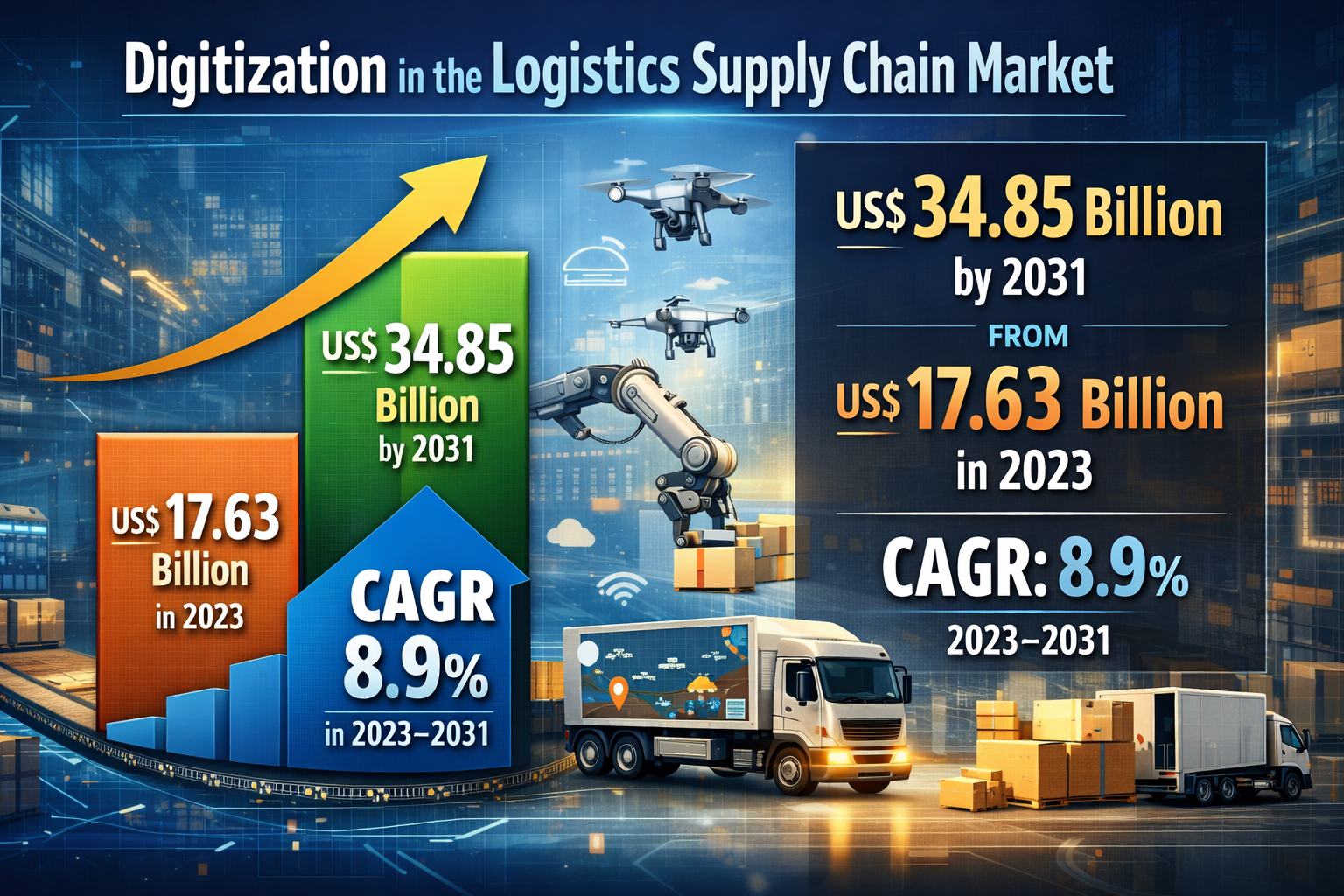
According To The Insight Partners, The Digitization in the logistics supply chain reaching US$ 34.85 billion by 2031, up from US$ 17.63 billion in 2023, with a compound annual growth rate (CAGR) of 8.9% during the forecast 2023–2031 .This growth is mainly driven by the rising need for efficient supply chain management solutions and the rapid expansion of the retail and e-commerce industries, which are encouraging companies to adopt advanced digital technologies in logistics operations.
Market Drivers and Trends
Rise of E-commerce and Retail
The surge in e-commerce activities has been a primary driver of digitization in the logistics supply chain. As consumer preferences shift towards online shopping, retailers are compelled to streamline their supply chain operations to meet rising customer expectations. This involves the adoption of digital solutions that enhance real-time tracking, order management, and inventory control. The ability to track shipments and manage logistics digitally allows companies to reduce operational costs, minimize errors, and improve service delivery.
Automation and Efficiency
Automation technologies are increasingly being integrated into logistics operations, significantly benefiting industries such as automotive, healthcare, and manufacturing. By reducing human intervention, these technologies not only lower the risk of errors but also enhance operational efficiency. For instance, automated warehousing solutions and robotics in fulfillment centers have become commonplace, enabling faster processing of orders and improved accuracy in inventory management.
Government Initiatives
Government investments in smart logistics solutions present substantial opportunities for market growth. Initiatives aimed at promoting digitalization are gaining traction globally.Similarly, India’s budget allocation for freight corridors underscores the commitment to improving transport infrastructure, which is crucial for efficient supply chain operations.
Get a PDF Copy@ https://www.theinsightpartners.com/sample/TIPRE00013577
FAQ
1.How is e-commerce influencing the digitization of supply chains?
A: The surge in e-commerce has compelled retailers to streamline logistics operations, implement real-time tracking, and manage inventory digitally to meet rising customer expectations.
2.Which technologies are most impactful in logistics digitization?
A: Automation, robotics, artificial intelligence (AI), and machine learning (ML) are transforming operations by reducing errors, improving efficiency, and speeding up order fulfillment.
3.How is the market segmented?
A: The market is segmented by:
- Component: Software and services (software leads).
- Organization Size: Large enterprises dominate due to higher tech adoption.
- Industry: Retail and e-commerce contribute the largest share.
Segmentation Analysis
The digitization in the logistics supply chain market can be segmented based on components, organization size, and industry:
- By Component: The market is divided into software and services, with the software segment holding a larger share in 2023.
- By Organization Size: Large enterprises dominate the market, benefiting from greater resources to invest in advanced technologies.
- By Industry: The retail and e-commerce sector is the largest contributor, reflecting the sector's rapid growth and need for efficient logistics solutions.
Geographic Insights
Regionally, North America leads the market, driven by early adoption of technology and a robust retail environment. The United States, Canada, and Mexico are key players in this region. The rise in retail sales, alongside increasing internet penetration, has fostered a conducive environment for the growth of digital logistics solutions. In contrast, the Asia Pacific region is witnessing rapid growth due to expanding e-commerce markets in countries like China and India. The increasing purchasing power and internet accessibility in these regions further propel the demand for digitized supply chain solutions.
Key Players in the Market
Several prominent companies are shaping the digitization landscape in the logistics supply chain:
- SAP SE
- Oracle Corporation
- IBM
- Intel Corporation
- Infor
- Hexaware Technologies Limited
- HCL Technologies Limited
- Blue Yonder Group, Inc.
- ORBCOMM
- Ramco Systems
These companies are focusing on innovation and expanding their product offerings to meet the evolving needs of the logistics sector.
Future Outlook
The future of digitization in the logistics supply chain appears promising, with ongoing advancements in technology such as artificial intelligence and machine learning. These innovations will further enhance operational efficiencies, enabling businesses to adapt to changing market dynamics.
About The Insight Partners
The Insight Partners delivers market intelligence and consulting services to help clients make informed decisions. The firm covers industries such as Aerospace and Defense, Automotive and Transportation, Semiconductor and Electronics, Biotechnology, Healthcare IT, Manufacturing, Medical Devices, Technology, Media, and Chemicals and Materials.
Contact Information:
Email: sales@theinsightpartners.com
Website: www.theinsightpartners.com
Phone: +1-646-491-9876
Also Available in :
Korean German Japanese French Chinese Italian Spanish

 Arabic
 French
 Spanish
 Portuguese
 Deutsch
 Turkish
 Dutch
Dutch
 Italiano
 Russian
 Romaian
 Portuguese (Brazil)
 Greek
Greek