


How Coolant Hose Materials Impact Engine Cooling
Free
Public Transport
From an engineering perspective, the Automotive Coolant Radiator Hose is more than just a flexible rubber tube — it is a carefully designed component that must balance multiple demands. Understanding the materials and design constraints behind the Coolant Hose can shed light on why some hoses last longer and perform more reliably than others.
First, consider temperature. The coolant circulating through the hose can reach very high heat — especially when the engine is working hard. Meanwhile, the hose must resist pressure and flex without collapsing. For that reason, many radiator hoses are made from synthetic rubber or silicone. These materials are chosen because of their heat resistance and resilience. Some specialized hoses even use reinforced layers to improve durability under fusion of pressure and vibration.
Another important factor is chemical compatibility. The coolant itself often contains ethylene glycol or other additives. The hose material must resist chemical degradation. EPDM (ethylene propylene diene monomer) rubber is commonly used for this reason: it performs well under thermal stress and in contact with typical coolant chemistry. In some high-performance or industrial applications, more exotic materials, or reinforced structures, are used to prevent swelling or breakdown.
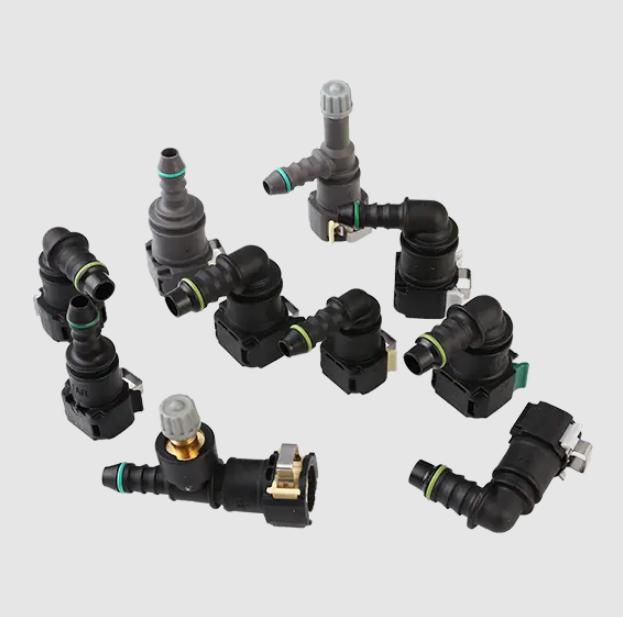
Design-wise, the shape of the hose matters a lot. In many vehicles, the Cooling System has tight packaging: the hose may have to wrap around engine components or avoid interfering with other parts. Hoses are often molded in specific shapes — upper radiator hose, lower hose, bypass hose — so they can integrate tightly within the engine bay. Universal or accordion-style hoses can help in custom applications, but molded ones offer better flow characteristics and fewer stress points.
Pressure is also key. As coolant circulates, the system builds pressure. Radiator hoses are designed to tolerate that pressure without bursting or deforming. According to expert sources, under typical conditions they may see up to 20 psi or more. For sections under suction (like returning to the water pump), some hoses have internal springs or reinforced walls to avoid collapse.
Finally, vibration and movement are major concerns. The engine moves, vibrates, and shifts slightly under load. Therefore, the Coolant Hose must remain flexible enough to absorb these dynamics without cracking or loosening. That means the design must prioritize not just static strength but dynamic durability.
In sum, the engineering behind an Automotive Coolant Radiator Hose involves careful trade-offs: temperature tolerance, chemical resistance, pressure handling, and flexibility. A well-designed hose helps ensure reliable coolant flow, contributes to thermal stability, and supports the long-term health of the cooling system.

 Arabic
 French
 Spanish
 Portuguese
 Deutsch
 Turkish
 Dutch
Dutch
 Italiano
 Russian
 Romaian
 Portuguese (Brazil)
 Greek
Greek